
Adda Avendaño / Photo: Jorge Aguilar
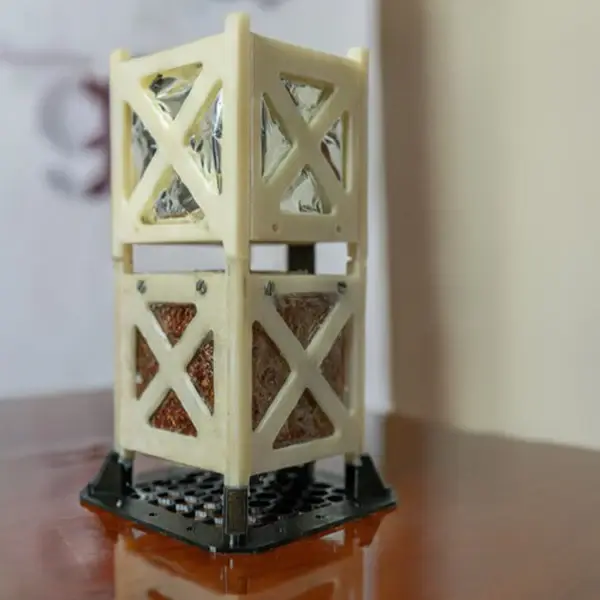
A prototype made from coconut and henequen fibers, developed at CECyT 19, is capable of housing electronic components.
Faced with the growing problem of space debris—now estimated at more than 130 million fragments orbiting Earth, according to the European Space Agency (ESA)—and the risks posed by the uncontrolled reentry of large titanium or steel fragments that may release toxic compounds, researchers at the Instituto Politécnico Nacional (IPN) have developed a biodegradable nanosatellite.
Built using natural fibers from coconut and henequen, combined with polyvinyl alcohol, the prototype was designed by Dr. Alejandro Cuautle Estrada, Dr. Bryan Ivan Quintanar Abarca, Dr. Cuauhtémoc Rafael González García, and Dr. Félix Omar Soto Barrón, under the leadership of Dr. Martín Guzmán Baeza from the Centro de Estudios Científicos y Tecnológicos (CECyT) 19 “Leona Vicario.”
The research team at this IPN campus began working in aerospace development four years ago. Their early efforts focused on combining biodegradable nanomaterials developed by Dr. Guzmán during his doctoral research, initially targeting aeronautical applications.
“We attended an event at the Centro de Desarrollo Aeroespacial (CDA), where we were introduced to the EMIDSS project (Experimental Module for Iterative Design for Satellite Subsystems) and met Dr. Mario Alberto Mendoza Bárcenas, who later invited us to join the fifth stratospheric mission,” recalled Cuautle Estrada.
For that mission, the team sent material samples to evaluate their behavior under extreme conditions. These included polypropylene (PP), polycarbonate (PC), acrylonitrile butadiene styrene (ABS), polylactic acid (PLA), glycol-modified polyethylene terephthalate (PETG), and polyvinyl alcohol (PVA), a water-soluble biodegradable polymer.
The results showed that, although biodegradable materials were not the most resistant under stratospheric conditions, several performed within acceptable limits, allowing the team to identify viable candidates for further development.
The project gained further relevance following events such as the fall of SpaceX Starship debris on Bagdad Beach in Matamoros, Tamaulipas, in June 2025, which caused environmental damage along several kilometers of coastline.
“The debris included metal, plastic, and hazardous materials that contaminated Mexican territory and threatened endemic species such as the Kemp’s ridley sea turtle. Environmental impact assessments are still ongoing,” warned Guzmán Baeza.
Another key reference was the launch of LignoSat in November 2024, the world’s first wooden CubeSat, developed by Kyoto University and Sumitomo Forestry to test sustainable materials in space.
Following their stratospheric experiments, the researchers developed a nanosatellite prototype using sisal (henequen), coconut fibers, and polyvinyl alcohol. The team was later invited to participate in the seventh EMIDSS mission.
“For this mission, we moved beyond test samples and built a full prototype using materials that showed a balanced performance—mechanical strength and biodegradability within approximately three months under outdoor conditions,” explained Dr. Guzmán.
When exposed to water, the structure can disintegrate within three days due to the rapid degradation of its components. Even so, it remained stable enough to withstand stratospheric flight conditions during the August 2025 mission.
The core objective of biodegradability is that, in the event of an uncontrolled reentry, the structure would decompose without releasing toxic substances into the environment. Only internal metallic components—such as aluminum, steel, gold, and silver used in electronics—would remain, eventually integrating naturally into the environment.
A central challenge in satellite engineering is ensuring that the structure can safely support its payload—the onboard electronic systems. The IPN-developed CubeSat (standard 10×10×10 cm configuration) was equipped with sensors to measure pressure, temperature, acceleration, position, time, and GPS location.
“In our operational stratospheric range, temperatures vary from minus 80°C to 150°C under direct solar exposure. Interestingly, we also found that natural fibers can help dissipate heat and protect electronic components,” said Guzmán Baeza.
This finding is particularly relevant in space engineering, where extreme thermal fluctuations demand highly efficient insulation systems. While conventional materials perform well, they are often environmentally harmful, making natural fibers a promising sustainable alternative.
Dr. Bryan Quintanar highlighted the lightweight nature of the material system. Since CubeSats must remain under 1.3 kilograms, reducing structural mass directly increases capacity for scientific payloads. Each 10×10 cm module weighs approximately 80 grams, making it significantly lighter than conventional aluminum-based nanosatellites while maintaining strong mechanical resistance.
“We’ve tried to break it, and without cutting tools it’s extremely difficult. It can bend or deform, but it doesn’t easily fracture,” Quintanar Abarca noted.
Given its potential, the CECyT 19 team has initiated patent procedures for a utility model covering both the composite material and its manufacturing process.
“This material is not limited to aerospace applications. It could be used in utensils, accessories, or toys. It is safe, non-toxic, and skin-friendly—the only limit is design creativity,” he added.
Following the success of EMIDSS 7, the team is now developing next-generation materials for future nanosatellite prototypes.
Current research includes the use of sargassum seaweed, a marine algae that accumulates along Mexican coasts due to rising ocean temperatures and nutrient pollution.
Additional experiments involve graphene combined with carbon fiber, aiming to further expand the possibilities of sustainable materials in aerospace engineering.

INSTITUTO POLITÉCNICO NACIONAL
D.R. Instituto Politécnico Nacional (IPN). Av. Luis Enrique Erro S/N, Unidad Profesional Adolfo López Mateos, Zacatenco, Alcaldía Gustavo A. Madero, C.P. 07738, Ciudad de México. Conmutador: 55 57 29 60 00 / 55 57 29 63 00.
Esta página es una obra intelectual protegida por la Ley Federal del Derecho de Autor, puede ser reproducida con fines no lucrativos, siempre y cuando no se mutile, se cite la fuente completa y su dirección electrónica; su uso para otros fines, requiere autorización previa y por escrito de la Dirección General del Instituto.

