
By Zenaida Alzaga / Photo: Jorge Aguilar
In response to the rapid spread and overgrowth of water hyacinth in several of the country’s reservoirs, researchers at the Instituto Politécnico Nacional (IPN) have developed a reactor that transforms this invasive plant into biochar, which can be used to generate energy for small communities and to enrich agricultural soils.
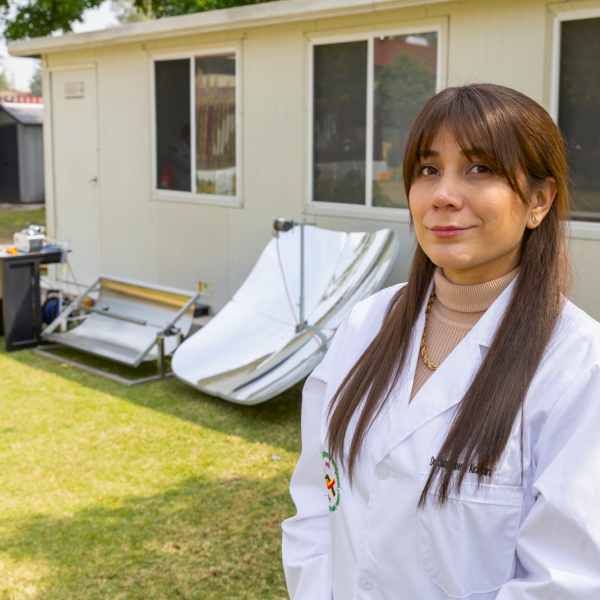
The project is led by a multidisciplinary team from the Interdisciplinary Center for Research and Studies on Environment and Development (CIIEMAD), including Adriana Nahúm Gutiérrez López, Paulina Gutiérrez Macías, Alejandra Pérez Galicia, Pedro Francisco Rodríguez Espinosa, Samuel Pérez Rodríguez, and Jacobo Tabla Hernández. The group designed and built a solar vacuum pyrolysis reactor to thermally decompose water hyacinth biomass.
As part of the research, the team is conducting physicochemical analyses of water in the Necaxa Hydroelectric System, located in the Sierra Norte region of Puebla, where the Tenango de las Flores, Necaxa, and Nexapa reservoirs converge.
This hydrological complex is a key source of drinking water and electricity, while also supporting local economies through ecotourism, fishing, food production, and other activities. However, researchers note that high concentrations of water hyacinth (Eichhornia crassipes) have been recorded in several reservoirs nationwide. As a floating plant, it spreads rapidly across water surfaces—a process associated with eutrophication—causing blockages in pipes and hydraulic infrastructure, limiting sunlight penetration, and accelerating the decomposition of organic matter through bacterial and microbial activity.
To address this challenge, the team developed a reactor consisting of a stainless-steel chamber equipped with valves and hoses connected to a vacuum pump, which removes air and oxygen from the system.
According to the research team, the composition of water hyacinth—rich in polysaccharides such as cellulose and hemicellulose, as well as phenolic polymers like lignin—makes it suitable for conversion into carbon-based fuel.
For biochar production, the plant is harvested from reservoirs, washed, sun-dried, and ground into fine particles. The material is then placed inside the reactor, which is positioned within a parabolic solar concentrator to reach temperatures of approximately 300°C for one hour. Condensable gases are captured using a cold trap, and once the process is complete, the reactor is allowed to cool before the biochar is collected. The resulting biochar is compacted into small cylinders or briquettes that can be used as fuel for thermal energy generation or cooking.
Dra. Gutiérrez López emphasized that the technology is designed to be replicated in small communities that depend on these reservoir systems, as it is simple to build, cost-effective, and easy to operate.

INSTITUTO POLITÉCNICO NACIONAL
D.R. Instituto Politécnico Nacional (IPN). Av. Luis Enrique Erro S/N, Unidad Profesional Adolfo López Mateos, Zacatenco, Alcaldía Gustavo A. Madero, C.P. 07738, Ciudad de México. Conmutador: 55 57 29 60 00 / 55 57 29 63 00.
Esta página es una obra intelectual protegida por la Ley Federal del Derecho de Autor, puede ser reproducida con fines no lucrativos, siempre y cuando no se mutile, se cite la fuente completa y su dirección electrónica; su uso para otros fines, requiere autorización previa y por escrito de la Dirección General del Instituto.

