
Reporter: Enrique Soto / Photographer: Jorge Aguilar
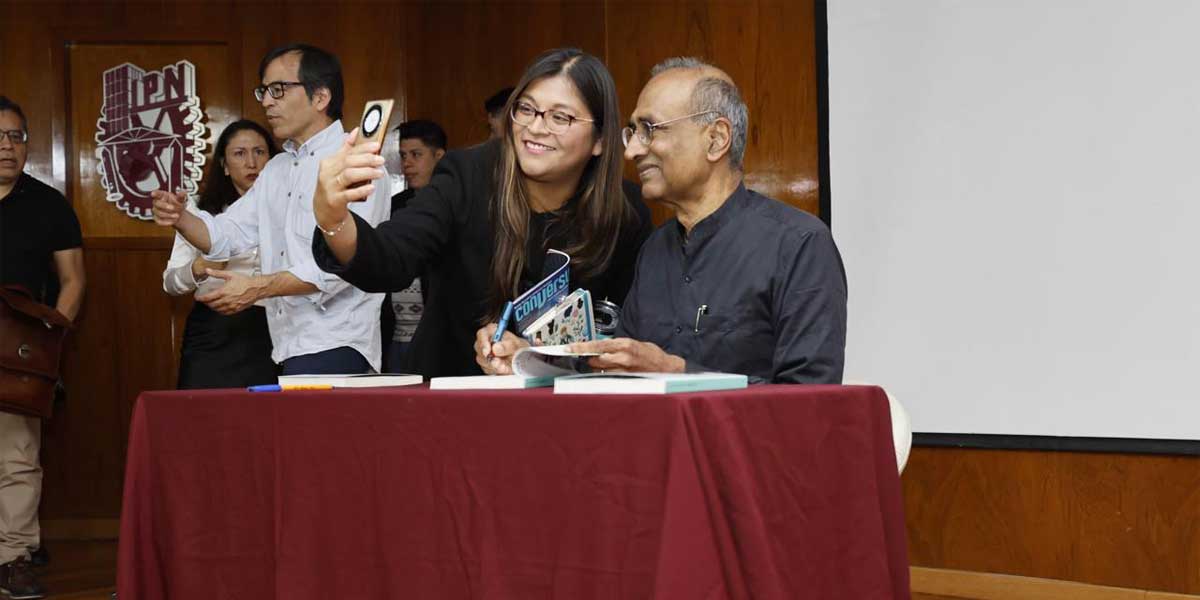
As part of the Conversus Talks series, Venki Ramakrishnan shared insights, experiences, and reflections on the science of aging.
Medications with safer and more precise dosing that target diseased cells, mechanisms to activate stem cells, and cellular reprogramming aimed at restoring metabolic function are among the most promising scientific approaches to slowing cellular aging, affirmed 2009 Nobel Laureate in Chemistry Venki Ramakrishnan during his visit to the Instituto Politécnico Nacional (IPN).
The remarks were delivered in his keynote lecture, “Conversus Talks: The Nobel Laureate Who Deciphered the Center of Life and the Code of Death.”
Speaking before faculty members, researchers, and students of the Escuela Superior de Ingeniería Química e Industrias Extractivas (ESIQIE), the Indian-born scientist—who holds American and British citizenship and a Ph.D. in physics, and who is renowned for his groundbreaking research on the ribosome, the molecular machine responsible for protein synthesis within cells—shared insights from his scientific journey, along with personal stories and reflections on his work.
Presenting his book, Why We Die: The New Science of Aging and the Quest for Immortality, Ramakrishnan stressed that there are no shortcuts for emerging countries seeking to advance their scientific capacity.
Nations must invest in sending young researchers to train in global centers of frontier science and, above all, provide the support and incentives needed for them to return home and help cultivate the next generation of scientists.
He noted that China and India adopted this strategy seriously, enabling them to generate new knowledge and drive their development. He added that scientific leadership initially flourished in Europe after the world wars, but later shifted to the United States, which made major investments in research—investments that continue to sustain its leadership, alongside countries like Japan. “Even within the United States, scientific knowledge is not evenly distributed; much of it is concentrated in California,” he remarked.
Ramakrishnan highlighted that scientific advances have extended life expectancy from about 40 to 80 years—nearly doubling the human lifespan. He emphasized that young people are best positioned to make groundbreaking contributions to science because they possess a healthy, highly adaptable brain. “As the years go by, the mind also begins to age,” he said.
He urged young scientists to pursue projects that truly interest them, as sustained curiosity is key to overcoming the demands of laboratory work. “Lab work is hard. That’s why you must choose problems you genuinely care about,” he stressed.
When asked by IPN researchers whether new pandemics caused by resistant bacteria or viruses could emerge, Ramakrishnan replied that the scientific community primarily addresses phenomena already visible in the present, and rarely develops solutions for events that have not yet occurred.

INSTITUTO POLITÉCNICO NACIONAL
D.R. Instituto Politécnico Nacional (IPN). Av. Luis Enrique Erro S/N, Unidad Profesional Adolfo López Mateos, Zacatenco, Alcaldía Gustavo A. Madero, C.P. 07738, Ciudad de México. Conmutador: 55 57 29 60 00 / 55 57 29 63 00.
Esta página es una obra intelectual protegida por la Ley Federal del Derecho de Autor, puede ser reproducida con fines no lucrativos, siempre y cuando no se mutile, se cite la fuente completa y su dirección electrónica; su uso para otros fines, requiere autorización previa y por escrito de la Dirección General del Instituto.

