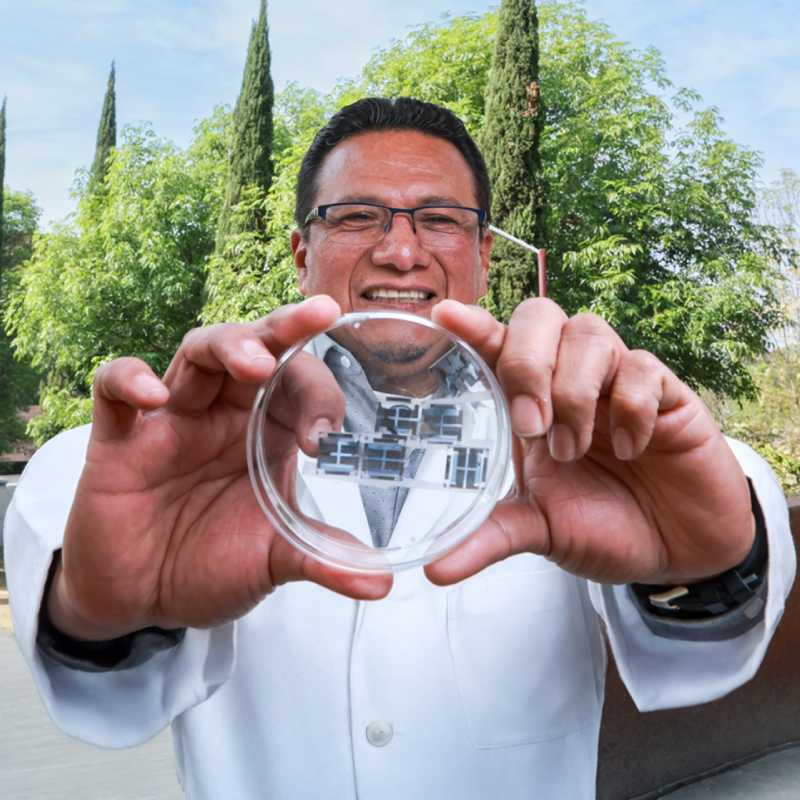
• Researchers from UPIITA and the Universitat Rovira i Virgili (Tarragona, Spain) are developing devices capable of generating electricity from both solar and artificial light
• Three master’s students and one doctoral candidate from the IPN have completed research stays at the Spanish institution
In collaboration with the Universitat Rovira i Virgili in Tarragona, Spain, the Instituto Politécnico Nacional (IPN) is advancing the development of next-generation organic solar cells capable of generating electricity from both sunlight and artificial light sources, including conventional indoor lighting.
Designed to power low-consumption household devices, the technology aims to reduce reliance on disposable batteries and contribute to more sustainable energy solutions in both countries. Over time, this innovation could become a viable alternative for expanding clean energy options and strengthening sustainability efforts.
The project, titled Fabrication, Modeling, and Simulation of Organic Solar Cells, is led by Luis Martín Reséndiz Mendoza, head of the Organic Devices Laboratory at the Unidad Profesional Interdisciplinaria en Ingeniería y Tecnologías Avanzadas (UPIITA). The initiative also involves Lluis Francisco Marsal Garví, researcher at the Universitat Rovira i Virgili, and Magaly Ramírez Como, researcher in the Department of Applied Physics at the Centro de Investigación y de Estudios Avanzados (CINVESTAV), Unidad Mérida.
This collaboration aligns with the national science and research policies promoted by the administration of President Claudia Sheinbaum Pardo and advances in accordance with the strategic guidelines of the Ministry of Public Education, led by Mario Delgado Carrillo.
Reséndiz Mendoza noted that three master’s students and one doctoral candidate from the IPN have undertaken research stays at the Spanish university’s laboratories to participate in the fabrication of the solar cells. “At UPIITA, we measure electrical properties and analyze physical phenomena through electrical modeling and simulation. We then share this data with our colleagues in Spain to refine processes and enhance device performance,” he explained.
Organic solar cells are considered third-generation photovoltaic devices. They are described as “organic” because they use carbon-based materials, such as polymers (plastics), to convert light into electricity through the photovoltaic effect.“Their main advantages are flexibility and transparency, which allow them to be integrated into everyday environments—for example, in building and residential windows,” he added.
According to the researcher—who holds a Ph.D. in Electrical Engineering and is a Level I member of Mexico’s National System of Researchers (SNII)—first-generation solar cells are silicon-based, using an element abundant in the Earth’s crust. Second-generation cells are made from inorganic materials, typically offering lower efficiency than silicon-based technologies.
The organic solar cells developed by the IPN in partnership with the Spanish university have achieved approximately 17 percent electrical efficiency under laboratory conditions—that is, in their capacity to convert solar energy into electricity. This represents a significant advance compared to research conducted in the 1980s, when efficiencies reached only about 1 percent.
Reséndiz Mendoza acknowledged advances made in Japan and Germany in the manufacturing of organic solar cells, noting that a German company currently produces commercial devices with efficiencies of up to 8 percent.
“These results confirm that the technology developed at the IPN is on par with global advancements. The current challenge for the international scientific community lies in extending the operational lifespan of these cells and further increasing their efficiency,” he stated.
For more information, visit www.ipn.mx

INSTITUTO POLITÉCNICO NACIONAL
D.R. Instituto Politécnico Nacional (IPN). Av. Luis Enrique Erro S/N, Unidad Profesional Adolfo López Mateos, Zacatenco, Alcaldía Gustavo A. Madero, C.P. 07738, Ciudad de México. Conmutador: 55 57 29 60 00 / 55 57 29 63 00.
Esta página es una obra intelectual protegida por la Ley Federal del Derecho de Autor, puede ser reproducida con fines no lucrativos, siempre y cuando no se mutile, se cite la fuente completa y su dirección electrónica; su uso para otros fines, requiere autorización previa y por escrito de la Dirección General del Instituto.