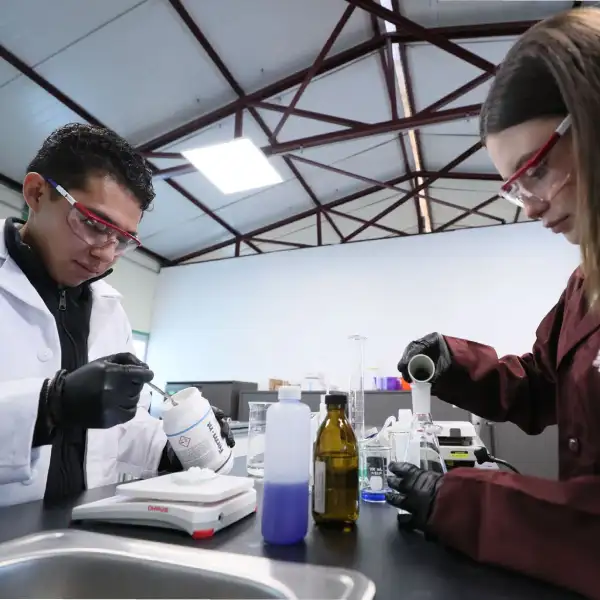
• The project developed at UPIEM aims to address both flooding and water scarcity, which affect communities across Mexico.
• Packaging made from this IPN-developed plastic could purify collected rainwater or water stored after household laundry use.
Students at the Instituto Politécnico Nacional (IPN) are working on a project to develop a plastic that dissolves in water and, when exposed to sunlight, purifies the surrounding liquid. This process could help mitigate flooding by preventing conventional plastics from clogging drainage systems—simplify the purification of harvested rainwater, and facilitate water reuse.
At the Unidad Profesional Interdisciplinaria de Energía y Movilidad (UPIEM) of IPN, students Cristian Martínez Domínguez and Delia Guadalupe Robles Galeana, eighth-semester students in the Energy Systems and Smart Grids Engineering program, are leading the development of this initiative.
Cristian Martínez explained that the proposal has been named “Puribag,” a plastic material that has been under development for at least a year and a half.
“Puribag is a response to the massive use of plastics in Mexico—not only in shopping bags, but also in product wraps, containers, and labels—which in most cases are discarded after a single use,” he noted.
The project is part of the IPN Director General Arturo Reyes Sandoval’s work plan, aligned with the educational strategy promoted by President Claudia Sheinbaum Pardo and in accordance with the guidelines set by the Secretary of Public Education, Mario Delgado Carrillo.
Institutions collaborating in the development of Puribag include Universidad Autónoma Chapingo; the Centro de Investigación y de Estudios Avanzados (Cinvestav); the Centro de Investigación en Ciencia Aplicada y Tecnología Avanzada (CICATA), Legaria Unit; and
the UNAM Institute of Biotechnology.
Martínez added that one of Puribag’s main objectives is its use in households that collect rainwater due to water shortages, allowing the material to assist in purifying the stored water.
According to the IPN student, the material could also purify water collected after bathing or from washing machines.
Delia Robles explained that achieving a plastic capable of dissolving in water while purifying it through solar exposure has required extensive testing and the support of the participating institutions.
The first product developed using this plastic is a bag, which is currently undergoing testing to verify its resistance to different weights and temperatures.
Both students anticipate that Puribag could lead to solutions for various industries, including pharmaceutical containers and beverage packaging.
Robles recalled that when conventional plastics end up in canals or rivers, they can take up to a thousand years to degrade—contributing significantly to flooding.
Environmental degradation processes, river overflows recorded in Mexico, ongoing water shortages, and the need to reuse water in households across different regions of the country were key factors that motivated the development of this solution, the students explained.
For more information, visit www.ipn.mx

INSTITUTO POLITÉCNICO NACIONAL
D.R. Instituto Politécnico Nacional (IPN). Av. Luis Enrique Erro S/N, Unidad Profesional Adolfo López Mateos, Zacatenco, Alcaldía Gustavo A. Madero, C.P. 07738, Ciudad de México. Conmutador: 55 57 29 60 00 / 55 57 29 63 00.
Esta página es una obra intelectual protegida por la Ley Federal del Derecho de Autor, puede ser reproducida con fines no lucrativos, siempre y cuando no se mutile, se cite la fuente completa y su dirección electrónica; su uso para otros fines, requiere autorización previa y por escrito de la Dirección General del Instituto.