• A research team at ENCB aims to convert fruit, vegetable, and crop peels into raw material for fully biodegradable utensils.
• The project is 75 percent complete; the prototypes are expected in six to twelve months and will undergo microbiological and safety testing beforehand.
Researchers at the Instituto Politécnico Nacional (IPN) are transforming agro-industrial waste into an eco-friendly alternative by using melon, papaya, pineapple, mango, banana, and avocado peels—as well as vegetable scraps—to create the raw material needed to produce fully biodegradable, environmentally friendly plates.
Led by Dr. Elier Ekberg Neri Torres at the National School of Biological Sciences (ENCB), the project offers a dual contribution: it reduces the environmental impact of organic waste and generates safe products that strengthen the circular economy. This postdoctoral initiative brings together science, innovation, and environmental awareness.
The project aligns with the work plan of IPN Director General, Dr. Arturo Reyes Sandoval, and follows the guidelines set by President Claudia Sheinbaum Pardo and the Secretary of Public Education, Mario Delgado Carrillo.
A member of the team and a specialist in food loss and waste recovery, Neri Torres, explained that the ultimate goal is to create utensils that degrade in a very short time.
“Many plastic products are marketed as biodegradable even though they are not fully degradable, which creates a false perception of sustainability,” he said.
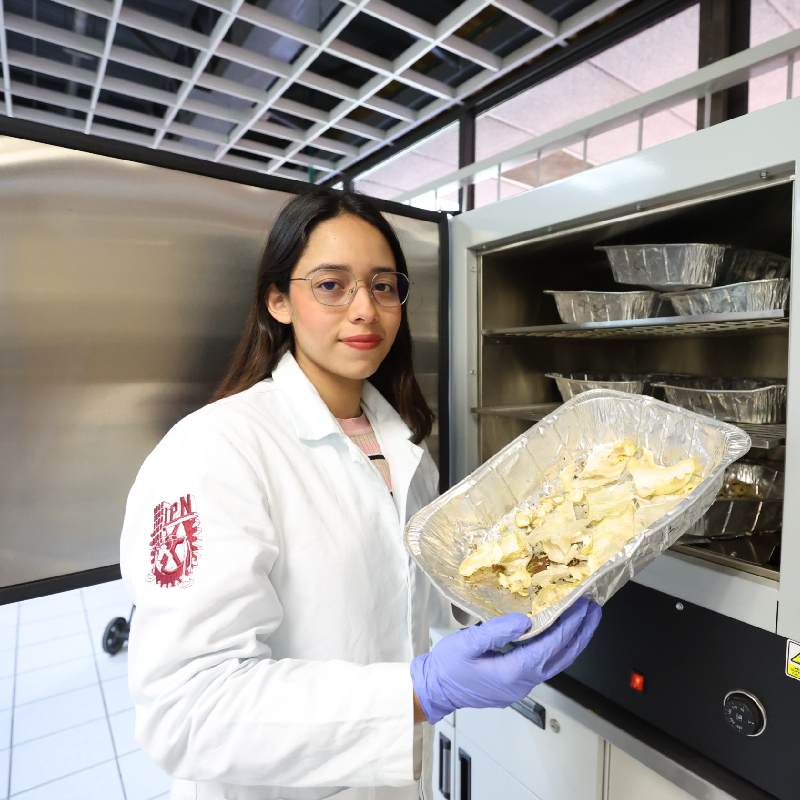
The team collects vegetable waste daily from the school cafeteria and subjects it to a drying process that uses solar energy, specialized ovens, and convection heaters.
Regarding product performance, Neri Torres noted that although the team focuses on developing plates for immediate use, they also analyze the possibility of adding natural antimicrobial agents to extend shelf life without introducing contaminants.
The project is 75 percent complete, so that the prototypes could be ready within six to twelve months. Before entering the market, the utensils must pass microbiological and safety tests, as well as a scale-up phase using a larger-capacity reactor. Two scientific articles are currently in preparation, and the researchers expect to pursue intellectual property protection for the technology.
The research team also includes Dr. Selene Montserrat García Solares from the Mexican Center for Cleaner Production (CMP+L) at the IPN; Biochemical Engineering intern Elsa Sandoval Santamaría; and Environmental Systems Engineering student Ivonne Gutiérrez Sánchez. Their work aligns with the United Nations Sustainable Development Goals.
The initiative could also be implemented in the State of Mexico, where nearly 18,000 tons of agro-industrial waste are generated annually—an invaluable resource for boosting biodegradable plate production.
For the researchers, giving organic waste a second life is a key step toward reducing carbon footprints and advancing green chemistry principles. “We can’t ask people to eat certain fruit and vegetable peels, but we can turn them into useful products,” Dr. Neri Torres said.
For more information, visit www.ipn.mx

INSTITUTO POLITÉCNICO NACIONAL
D.R. Instituto Politécnico Nacional (IPN). Av. Luis Enrique Erro S/N, Unidad Profesional Adolfo López Mateos, Zacatenco, Alcaldía Gustavo A. Madero, C.P. 07738, Ciudad de México. Conmutador: 55 57 29 60 00 / 55 57 29 63 00.
Esta página es una obra intelectual protegida por la Ley Federal del Derecho de Autor, puede ser reproducida con fines no lucrativos, siempre y cuando no se mutile, se cite la fuente completa y su dirección electrónica; su uso para otros fines, requiere autorización previa y por escrito de la Dirección General del Instituto.