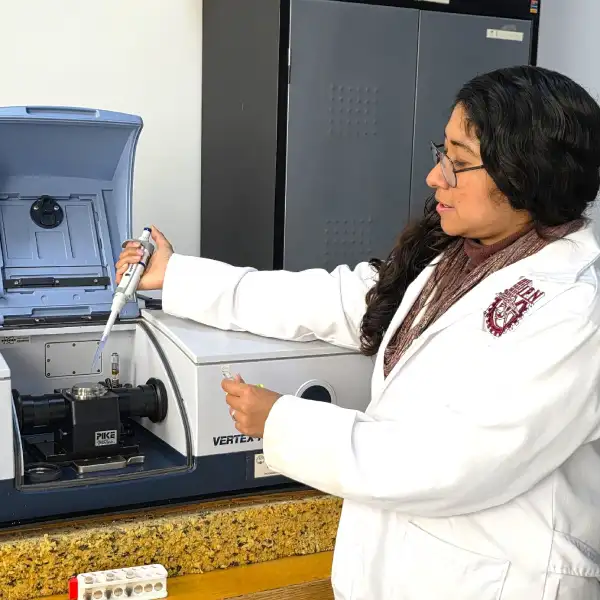
• The project, led by CIBA Tlaxcala, aims to provide an affordable test with results available within minutes, avoiding invasive diagnostic procedures such as biopsies
• In vitro trials have already demonstrated high effectiveness; the next stage will seek to formalize agreements to test the technology using patient samples
The Instituto Politécnico Nacional (IPN) is advancing the development of a biosensor that could transform the detection of Helicobacter pylori infection, a bacterium that affects a large portion of the Mexican population and is associated with chronic gastritis, ulcers, and stomach cancer.
Researchers at the Centro de Investigación en Biotecnología Aplicada (CIBA) Tlaxcala are developing this technology under the leadership of scientist Abdú Orduña Díaz, in collaboration with MSc and PhD candidate Cecilia Díaz Pérez, as well as researcher Zeus Saldaña Ahuactzi, who is currently conducting a postdoctoral fellowship.
Through this initiative, the IPN reaffirms its historic commitment to placing science and technology at the service of society to improve quality of life, in line with the initiatives promoted by President Claudia Sheinbaum Pardo and supported by Minister of Public Education Mario Delgado Carrillo.
Díaz Pérez explained that one of the main challenges in combating this disease lies in diagnosis, as existing tests tend to be costly, invasive, or insufficiently accurate. In many cases, patients only receive treatment to relieve symptoms, without confirmation of complete bacterial eradication.
The biosensor represents a globally unprecedented technology for detecting Helicobacter pylori. For this reason, the research team plans to pursue patent registration at a later stage, the researcher noted.
Díaz Pérez also pointed out that, although colloidal biosensors exist for identifying other bacteria, none currently target this microorganism. This distinction gives the technology strong potential as an accessible tool for early diagnosis and the prevention of more severe conditions, such as gastric cancer.
Unlike conventional methods, this colloidal biosensor—suspended in a specific liquid medium—aims to deliver an affordable test with results obtained in just a few minutes. This capability would enable the early detection of infections and help avoid invasive diagnostic procedures, such as biopsies.
Once assembled, the biosensor integrates into a liquid solution where it can interact directly with biological samples, such as saliva. If the bacterium is present, it binds specifically to the biosensor, enabling easy separation from the rest of the sample through the use of a magnet. This process simplifies sample purification and analysis, even in complex matrices, and allows rapid result generation.
Dr. Orduña, a Level II member of the National System of Researchers (SNII), reported that in vitro assays have demonstrated 100 percent effectiveness of the biosensor in detecting the infectious agent. He added that the use of magnetic particles and a magnet enables fast, efficient, and low-cost detection, with potential applications in clinical settings and in communities with limited access to specialized diagnostic studies.
With 70 percent progress completed, the project has already produced positive laboratory results. The next phase will focus on validating its performance using real samples through agreements with the health sector, to apply the technology in public hospitals and primary care centers at a lower cost than existing diagnostic tests.
For more information, visit www.ipn.mx

INSTITUTO POLITÉCNICO NACIONAL
D.R. Instituto Politécnico Nacional (IPN). Av. Luis Enrique Erro S/N, Unidad Profesional Adolfo López Mateos, Zacatenco, Alcaldía Gustavo A. Madero, C.P. 07738, Ciudad de México. Conmutador: 55 57 29 60 00 / 55 57 29 63 00.
Esta página es una obra intelectual protegida por la Ley Federal del Derecho de Autor, puede ser reproducida con fines no lucrativos, siempre y cuando no se mutile, se cite la fuente completa y su dirección electrónica; su uso para otros fines, requiere autorización previa y por escrito de la Dirección General del Instituto.