
Reporter: Adda Avendaño / Photographer: Israel Vera
Using cat whiskers as a reference to develop a robot is a UPIITA-led project that has been published as a scientific article and featured in an interview for the prestigious journal Science.
By observing and analyzing the sensitivity of cat whiskers, students from the Interdisciplinary Professional Unit in Engineering and Advanced Technologies (UPIITA) of the Instituto Politécnico Nacional (IPN), under the guidance of a multidisciplinary team of specialists, developed a robotic prototype inspired by felines. The device is capable of detecting obstacles or objects in confined, dark, or hard-to-reach spaces.
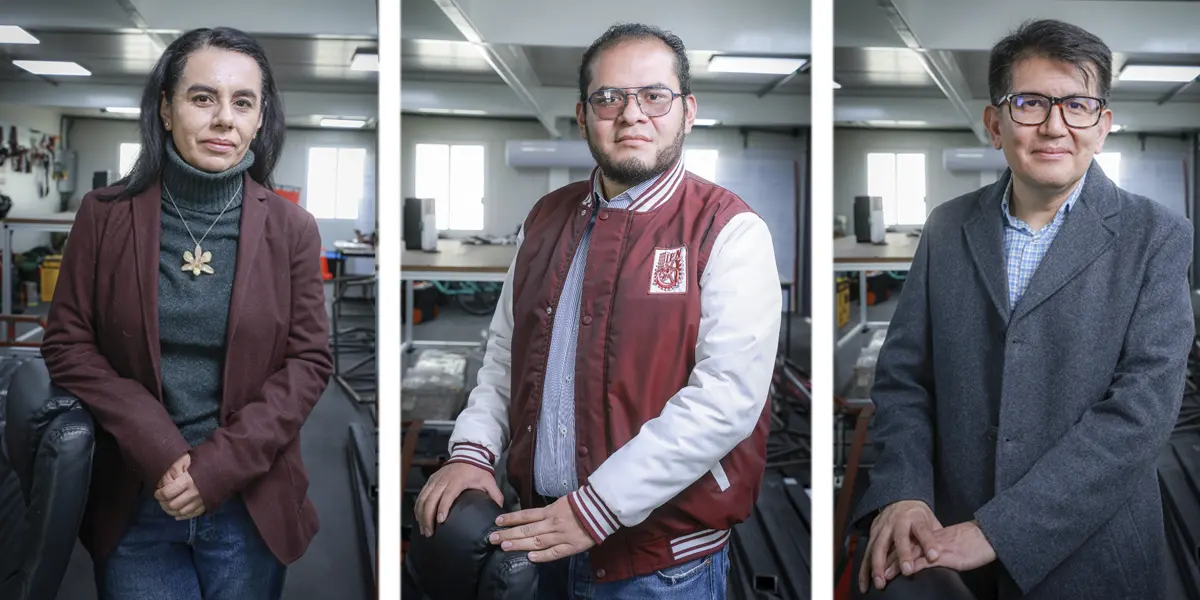
Dr. Ricardo Alan Cortez Vega, from the Interdisciplinary Professional Unit of Engineering “Alejo Peralta” Puebla (UPIIAP), explained that cats use their whiskers to perceive their surroundings, assess whether they can pass through a space, and orient themselves safely through contact with objects. However, he noted a key feature: whiskers do not detect stimuli on their own, as they are composed solely of keratin and contain no nerve endings.
“The nerve endings are located at the base of the whiskers, where blood vessels are present. That is where movement, bending, or contact is detected. This led to the idea of reproducing this biological mechanism in a mechatronic prototype capable of detecting objects in confined environments,” he explained.
To address this challenge, students Yessica María Araceli Galicia Montoya, Luis Aaron Cruz Cambray, and Josué Armando Jaimes Olivera studied seven test subjects and collected their whiskers to analyze their structure under a microscope. They also recorded and analyzed videos of cats reacting while eating, playing, or listening to recordings of younger kittens.
Under the guidance of professors Norma Beatriz Lozada Castillo and Alberto Luviano Juárez, both from UPIITA; Marco Antonio Sandoval Chileño, from the Interdisciplinary Professional Unit of Energy and Mobility (UPIEM); Dr. Karla Rincón Martínez, from the University of Kentucky (UK); and Dr. Alan Cortez Vega from UPIIAP, the students tested multiple combinations for artificial whiskers and built a functional prototype.
Dr. Ricardo Cortez explained that the whiskers were made using two materials: an outer flexible resin produced through 3D printing, featuring a hollow core filled with silicone. Based on video analysis, the team determined that the whiskers should exhibit two types of motion: transverse and rotational.
Since the whiskers themselves do not provide direct sensing, Dr. Norma Lozada explained that the robotic prototype incorporates a technology known as an Extended State Observer (ESO), positioned at the base of the whiskers. This is an automatic control technique used in systems analysis.
“When the artificial whisker is not in contact with an object, the disturbance affecting the motor is minimal. However, when it brushes against or collides with an object, the disturbance increases. This allows us to obtain a signal that is analyzed in the frequency domain to identify the object’s characteristics,” she noted.
To process the data generated by vibrations of the artificial whiskers upon contact, Dr. Marco Sandoval added that a high-performance processing board was used. The information is transferred to a PC via USB for analysis and conversion.
“The result is a graph from which we extract frequency components and feed them into two simple classifiers—decision trees and support vector machines—allowing us to identify materials such as wood, plastic, and metal,” he explained.
Dr. Alberto Luviano emphasized that biological and social systems are highly complex and difficult to analyze using traditional physics alone. For this reason, alternative approaches such as software-based sensors—signal-processing algorithms that use measurable data—are employed to obtain meaningful information.
The development of the artificial cat whiskers was published as a scientific article in the open-access journal Processes (MDPI) under the title Object Identification Based on Extended State Observer on Artificial Cat Whiskers on October 29, 2025. The research also led to an interview with Dr. Ricardo Cortez, published in the prestigious scientific journal Science in November 2025.

INSTITUTO POLITÉCNICO NACIONAL
D.R. Instituto Politécnico Nacional (IPN). Av. Luis Enrique Erro S/N, Unidad Profesional Adolfo López Mateos, Zacatenco, Alcaldía Gustavo A. Madero, C.P. 07738, Ciudad de México. Conmutador: 55 57 29 60 00 / 55 57 29 63 00.
Esta página es una obra intelectual protegida por la Ley Federal del Derecho de Autor, puede ser reproducida con fines no lucrativos, siempre y cuando no se mutile, se cite la fuente completa y su dirección electrónica; su uso para otros fines, requiere autorización previa y por escrito de la Dirección General del Instituto.

