
Reporter: Rocío Castañeda / Photos: CIIDIR Durango and CBG
This research in Durango and Tamaulipas examines the genetic makeup of agricultural pests to mitigate crop losses and strengthen food security.
Given the importance of safeguarding food security in Mexico and mitigating the damage caused by parasitic insects to staple crops in Durango and Tamaulipas, specialists from the Instituto Politécnico Nacional (IPN) are conducting research into the genetic composition and complexity of agricultural pests to propose effective control strategies.
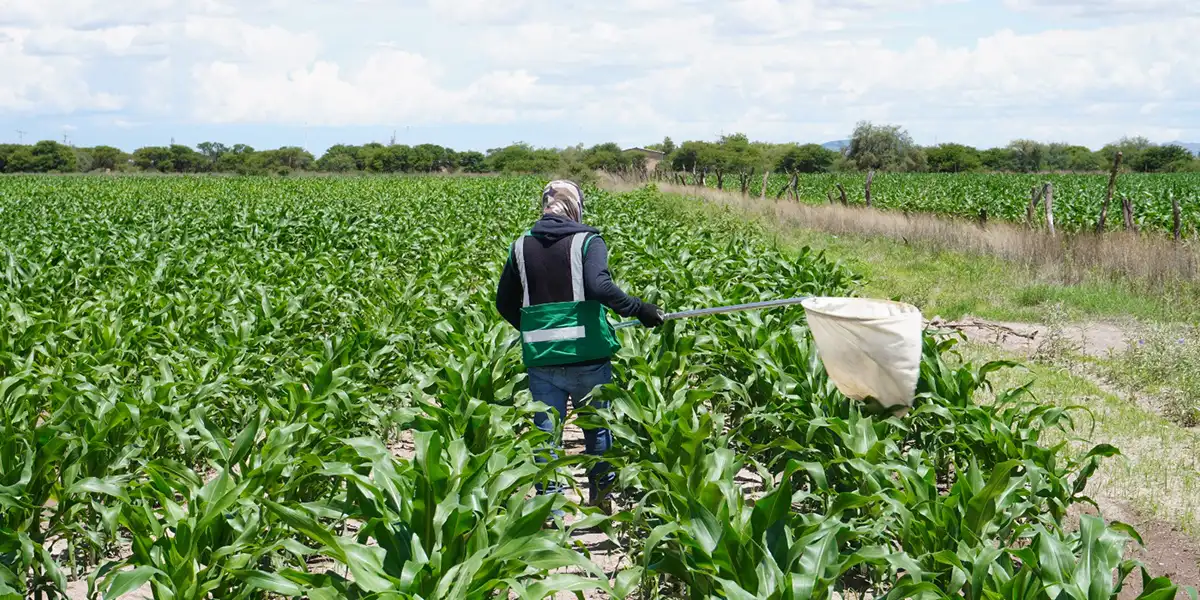
Through a joint effort, researchers from the Centro Interdisciplinario de Investigación para el Desarrollo Integral Regional (CIIDIR), Durango Unit, and the Centro de Biotecnología Genómica (CBG), located in Reynosa, Tamaulipas, are monitoring insect communities in sorghum, maize, and bean crops, as well as grasslands in both states. The objective is to detect genetic and environmental variations that influence pest behavior and impact.
The research also aims to characterize species richness and diversity across spatial and temporal scales, identifying dominant and rare species, including those classified as agricultural pests.
Under the project titled “Entomological richness and diversity in two contrasting environments in northern Mexico: Exploring sustainability and temporal and spatial patterns of selected groups of interest,” the IPN research team conducts weekly insect sampling—covering pests, predators, and parasitoids—using a range of collection techniques, followed by detailed taxonomic classification.
Among the pest species under study are the fall armyworm, corn earworm, maize weevil, armyworm, bean leaf beetle, yellow aphid, kissing bugs or cone-nosed bugs, measuring worm (possibly Mocis sp.), lady beetles (various Coccinellidae), wireworms (Elateridae), and green lacewings (Chrysopidae).
Did you know?
The presence of parasitic insects in crops can reduce annual agricultural production by up to 60 percent, leading to higher prices for consumers.
According to the research, coordinated by Uriel Hernández Salinas, professor-researcher at the Entomology and Wildlife Laboratories of CIIDIR Durango, pest infestations can significantly decrease crop yields, directly impacting the cost of staple foods for the Mexican population.
Nadia Angélica Fernández Santos, PhD, from the CBG, explained that the project focuses on Durango and Tamaulipas because these regions are biogeographically and climatically contrasting. This contrast allows researchers to observe variations in pest behavior—such as geographic movement and genetic changes—in response to climate variability. Genetic Variations The project comprises six action modules designed to develop a detailed description of population dynamics and morphological traits across annual (seasonal) variations. This approach seeks to better understand and describe key aspects of pest life cycles and migration patterns, which are essential for effective management.
The data collected are also critical for the genetic identification of pest insects through DNA barcoding, a methodology that provides a second level of analysis by establishing precise genetic profiles.
This analysis will help distinguish between resident and migratory populations and support the development of targeted recommendations to reduce the negative impact of pest insects on agricultural systems and natural ecosystems.
According to Dr. Hernández Salinas, a Level II member of Mexico’s National System of Researchers (SNII), the team will use the results to generate distribution projections through geographic information systems (GIS). These projections will enable the design of medium- and long-term management strategies, not only in the study areas but also in other regions of the country with similar climates and vegetation cover.
He emphasized that this research contributes directly to pest management, environmental sustainability, and increased grain production.
The project involves specialists from the Entomology and Wildlife Laboratories of CIIDIR Durango, as well as the Experimental Biotechnology, Molecular Biomedicine, and Genomic Biotechnology laboratories of the CBG in Reynosa, Tamaulipas.
The six modules that make up the project are led by Amanda Alejandra Oliva Hernández, José Navidad Gurrola Reyes, Uriel Hernández Salinas, Nadia Angélica Fernández Santos, María Berenice González Maldonado, Jesús Di Carlo Quiroz Velázquez, and Isaías Chairez Hernández, all of whom hold doctoral degrees.

INSTITUTO POLITÉCNICO NACIONAL
D.R. Instituto Politécnico Nacional (IPN). Av. Luis Enrique Erro S/N, Unidad Profesional Adolfo López Mateos, Zacatenco, Alcaldía Gustavo A. Madero, C.P. 07738, Ciudad de México. Conmutador: 55 57 29 60 00 / 55 57 29 63 00.
Esta página es una obra intelectual protegida por la Ley Federal del Derecho de Autor, puede ser reproducida con fines no lucrativos, siempre y cuando no se mutile, se cite la fuente completa y su dirección electrónica; su uso para otros fines, requiere autorización previa y por escrito de la Dirección General del Instituto.

