
By Adda Avendaño / Photo: Jorge Aguilar
This week commemorated the historic feat of Russian astronaut Yuri Gagarin, the first human to travel into outer space.
A Russian cosmonaut aboard the International Space Station (ISS) suffers an accident that causes severe lung injury. Unable to return to Earth, the astronaut requires urgent surgery in space. Faced with this extraordinary situation, the Russian space agency (Roscosmos) calls on thoracic surgeons to undergo a rigorous selection and training process to determine who will operate under extreme conditions.
With the screening of the film The Challenge, Cosmonautics Week—organized by the Secretariat of Research and Graduate Studies (SIP) through the Directorate for Science and Technology Outreach (DDiCyT) of the Instituto Politécnico Nacional (IPN)—came to a close. The program featured workshops and lectures commemorating the 65th anniversary of Yuri Gagarin’s historic first human spaceflight.
Before the screening—the first feature-length fiction film partially shot aboard the ISS—Martha Leticia Vázquez González, Secretary of Research and Graduate Studies at IPN, noted that Cosmonautics Week invited us to look toward the sky, but also toward what humanity can achieve when collaboration and determination come together to develop an idea.
“Every April 12, we celebrate the International Day of Human Space Flight in honor of Yuri Gagarin’s first journey into space. That moment changed history—not only because a human left Earth, but because it showed us that the limits of the known world could be expanded, ushering in what we now call frontier research,” she emphasized.
In the presence of the Ambassador of Russia to Mexico, Nikolay V. Sofinskiy, Vázquez González added that although the technological advancements of today did not exist at the time, there was a shared conviction that venturing into the unknown would expand human knowledge by forging paths never before explored. This drive transformed not only science, but also the way humanity tells its own story—reflected in this film, which succeeded in filming civilians in space to create the first fiction work produced beyond Earth.
In this context, she added, the Instituto Politécnico Nacional—now celebrating 90 years of history—continues to invest in pushing the boundaries of knowledge, as demonstrated by its Aerospace Development Center (CDA), which promotes strategic national projects such as the Ixtli satellite constellation, an initiative aimed at strengthening Mexico’s scientific and technological capabilities in the space sector.
Accompanied by Edmundo Omar Matamoros Hernández, head of DDiCyT, and the Mayor of Azcapotzalco, Nancy Marlene Núñez Reséndiz, Vázquez González expressed her appreciation for the presence of the diplomatic representation of the Russian Federation, whose scientific and space legacy holds a significant place in global history.
“This Cosmonautics Week reminds us of something essential: every great transformation once began as a hypothesis, and when science and imagination work together, even the stars cease to seem distant,” she said.
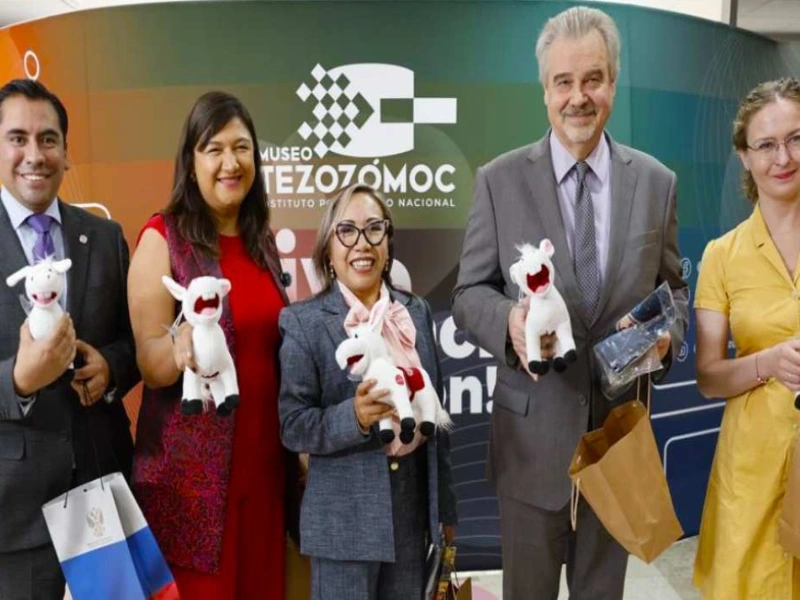
At the Tezozómoc Museum, part of DDiCyT, the Ambassador of Russia to Mexico, Nikolay V. Sofinskiy, remarked that in Russia, the image of Yuri Gagarin is held as sacred. Beyond a scientific achievement, he said, this first space mission symbolizes courage, hope, and humanity’s capacity to overcome the impossible.
“His smile, humility, and bravery made him a globally admired figure, and his legacy lives on in every corner of the world,” Sofinskiy stated.
Accompanied by his wife and Russian cultural attaché Alexandra Bekreneva, he explained that the film’s production was carried out solely by director Klim Shipenko, who took on the roles of cinematographer, makeup artist, and artistic director. To accomplish this, Shipenko underwent rigorous training and is now reportedly ready to undertake another film project on the Moon or Mars.

INSTITUTO POLITÉCNICO NACIONAL
D.R. Instituto Politécnico Nacional (IPN). Av. Luis Enrique Erro S/N, Unidad Profesional Adolfo López Mateos, Zacatenco, Alcaldía Gustavo A. Madero, C.P. 07738, Ciudad de México. Conmutador: 55 57 29 60 00 / 55 57 29 63 00.
Esta página es una obra intelectual protegida por la Ley Federal del Derecho de Autor, puede ser reproducida con fines no lucrativos, siempre y cuando no se mutile, se cite la fuente completa y su dirección electrónica; su uso para otros fines, requiere autorización previa y por escrito de la Dirección General del Instituto.

