
By Claudia Villalobos / Photos: Jorge Aguilar
In collaboration with UAM, researchers at ESIME Zacatenco are testing a biopolymer that promotes neuronal regeneration.
For decades, restoring mobility after a spinal cord injury has remained one of the most complex challenges in medicine. Today, however, a joint research project between the Instituto Politécnico Nacional (IPN) and the Universidad Autónoma Metropolitana (UAM) is opening new possibilities for individuals who have lost movement due to accidents, disease, or congenital conditions.
The study focuses on characterizing a conductive polymer derived from pyrrole, known as polypyrrole, whose properties may enable the reconnection of damaged nerve fibers and stimulate neuronal regeneration. The goal is to understand how this material behaves within the human body and assess its potential as a biological bridge capable of restoring communication between the brain and the rest of the body.
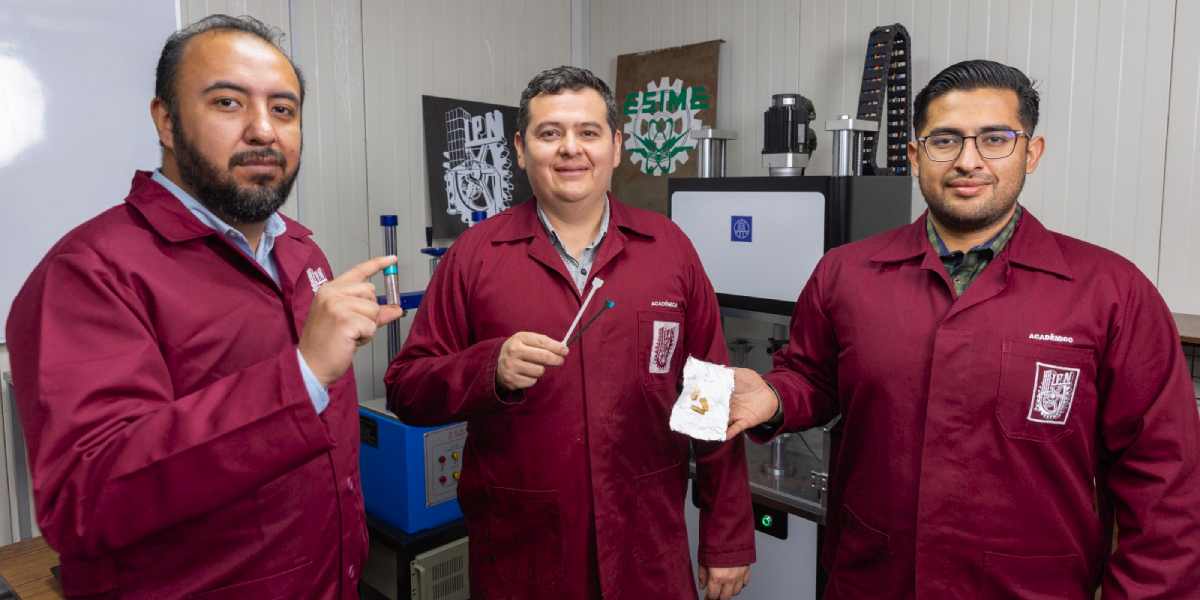
The project is led by Christopher René Torres San Miguel, a researcher at the Escuela Superior de Ingeniería Mecánica y Eléctrica (ESIME), Zacatenco Unit, in collaboration with UAM specialists. The initiative is supported by Mexico City’s Secretariat of Science, Technology, and Innovation (SECTEI) as part of broader efforts to generate research with direct impact on public health.
Dr. Torres San Miguel explained that the core of the research lies in understanding the dynamic behavior of the material used to produce small membranes designed to reconnect damaged nerve fibers. While polypyrrole had previously shown promising results in animal studies, its mechanical properties—such as elasticity, compression, and resistance to movement—had not been thoroughly analyzed.
Initial findings are encouraging. In studies involving rodents and non-human primates, the biopolymer demonstrated high biocompatibility and did not trigger adverse immune responses. When implanted in the spinal cord, the membranes acted as a bridge, enabling neuronal regeneration and the reconnection of damaged nervous tissue.
As a result, mice with spinal cord injuries recovered up to 85 percent of their mobility and sensitivity. These outcomes suggest that the material is not only compatible with neural tissue but also actively promotes its regeneration, marking a significant step toward future therapeutic applications.
The researcher, a Level II member of Mexico’s National System of Researchers (SNII), emphasized that before this technology can be applied in humans, it is essential to understand how the material behaves under different movement conditions. “An implant in the spinal cord must be resistant, flexible, and durable, as any failure could pose a serious risk to the patient,” he noted.
To address this, the research team produces test samples using 3D printing with biocompatible plastic, coats them with polypyrrole, and subjects them to stretching, torsion, and fatigue tests. These evaluations provide critical data on the material’s strength, flexibility, and durability before clinical consideration.
The project is structured in two phases: experimental and computational. Laboratory data are integrated into computer models built from MRI scans and CT imaging, allowing researchers to digitally reconstruct the spinal column and surrounding nervous tissue. These models simulate the polymer’s behavior in damaged areas, enabling performance predictions without additional animal testing—an approach aligned with ethical research standards.
In addition to Dr. Axayácatl Morales Guadarrama (UAM), the research team includes doctoral students Carlos Alberto Espinoza Garces and Elliot Alonso Alcántara Arreola. While some focus on experimental material analysis, others specialize in numerical simulation, a collaborative effort that has already resulted in three published scientific articles, with three more currently under review.
The team aims to advance toward preclinical studies and, eventually, human trials that could transform this scientific development into a viable treatment option, improving the quality of life for people living with spinal cord injuries.

INSTITUTO POLITÉCNICO NACIONAL
D.R. Instituto Politécnico Nacional (IPN). Av. Luis Enrique Erro S/N, Unidad Profesional Adolfo López Mateos, Zacatenco, Alcaldía Gustavo A. Madero, C.P. 07738, Ciudad de México. Conmutador: 55 57 29 60 00 / 55 57 29 63 00.
Esta página es una obra intelectual protegida por la Ley Federal del Derecho de Autor, puede ser reproducida con fines no lucrativos, siempre y cuando no se mutile, se cite la fuente completa y su dirección electrónica; su uso para otros fines, requiere autorización previa y por escrito de la Dirección General del Instituto.

