
By Adda Avendaño / Photos: Centro Interactivo Zigzag
Space exploration has long been one of humanity’s greatest drivers of technological advancement, as well as a powerful expression of our ability to imagine the future and collaborate in addressing global challenges, said Martha Leticia Vázquez González, Secretary of Research and Graduate Studies at the Instituto Politécnico Nacional (IPN).
Speaking at the inauguration of the exhibition “The Mexican Dream of Conquering Space” on March 12 at the Zigzag Interactive Center in Zacatecas—where it will remain open through June 12, from Tuesday to Sunday, 10:00 a.m. to 5:00 p.m.—Vázquez González highlighted that, over the past nine decades, the IPN has played a key role in building a strong foundation for Mexico’s scientific and technological development, guided by the principle that science must serve social well-being.
In this same spirit, she noted, the EMIDSS aerospace mission (Experimental Module for Iterative Design for Satellite Subsystems), developed by the IPN in collaboration with the Universidad Nacional Autónoma de México (UNAM) and the Instituto Tecnológico y de Estudios Superiores de Occidente (ITESO), is featured throughout the exhibition.
The mission focuses on conducting technological tests in the stratosphere.
Accompanied by Edmundo Omar Matamoros Hernández, Director of Science and Technology Outreach at the IPN, and Roberto Oswaldo Cruz Leija, Director of the Unidad Profesional Interdisciplinaria de Ingeniería Campus Zacatecas (UPIIZ), she recalled that the mission—aimed at gaining new perspectives on our planet—is coordinated by the IPN through the Agencia Espacial Mexicana, following an invitation from NASA.
“In this context, space research not only expands our understanding of the universe, but also helps us address the challenges facing our planet. At the IPN, we recognize that science does not take place solely in laboratories or research centers—it also happens in spaces that inspire scientific vocations,” she emphasized.
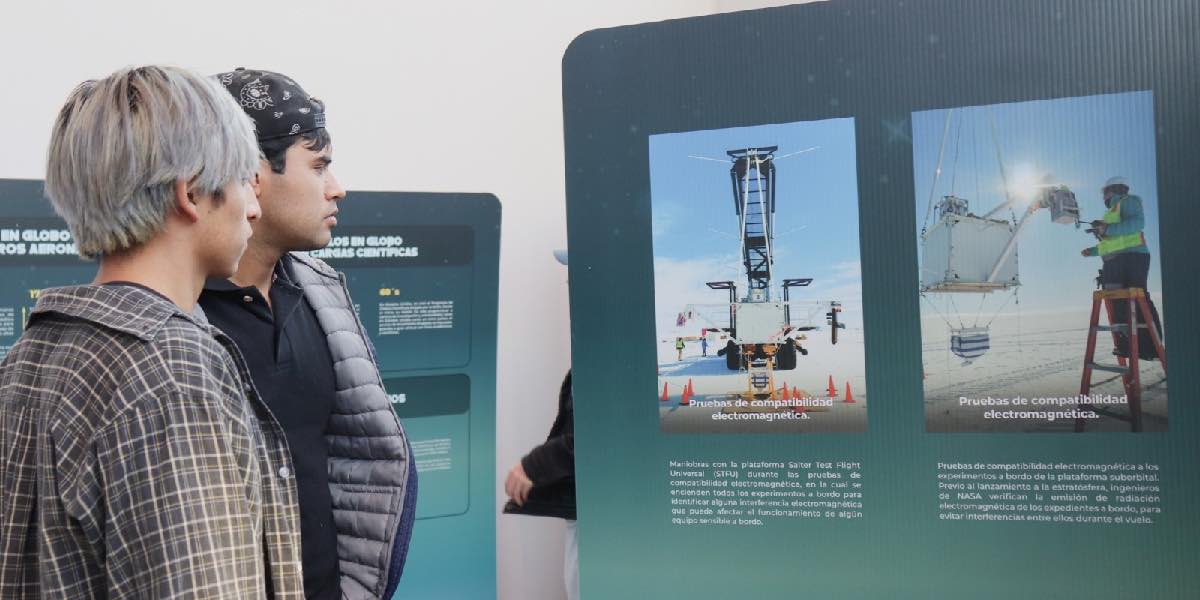
Hamurabi Gamboa Rosales, Director General of the Consejo Zacatecano de Ciencia, Tecnología e Innovación (COZCyT), explained that the exhibition features a collection of images from recent stratospheric missions, a timeline, testimonials, and two real modules used in these missions, developed with support from the National Aeronautics and Space Administration (NASA).
As part of this traveling exhibition—the first of its kind at the national level—Mario Alberto Mendoza Bárcenas, researcher at the IPN’s Centro de Desarrollo Aeroespacial (CDA), noted that the initiative seeks to bring the institution’s aerospace projects closer to broader audiences and to the Polytechnic community across the country.
“Great challenges and achievements begin with a dream. The key is ensuring that it does not remain a dream, but that we work to turn it into reality,” he said.
He recalled that the EMIDSS project originated as an aspiration to collaborate with NASA, which required years of effort, networking, and technological development to become a reality.
As part of the exhibition, a lecture series titled “Heading to the Stars” was also held on March 12 and 13, where specialists and researchers shared insights on Mexico’s participation in space missions, satellite technology development, artificial intelligence applications in space, and the challenges of space exploration.

INSTITUTO POLITÉCNICO NACIONAL
D.R. Instituto Politécnico Nacional (IPN). Av. Luis Enrique Erro S/N, Unidad Profesional Adolfo López Mateos, Zacatenco, Alcaldía Gustavo A. Madero, C.P. 07738, Ciudad de México. Conmutador: 55 57 29 60 00 / 55 57 29 63 00.
Esta página es una obra intelectual protegida por la Ley Federal del Derecho de Autor, puede ser reproducida con fines no lucrativos, siempre y cuando no se mutile, se cite la fuente completa y su dirección electrónica; su uso para otros fines, requiere autorización previa y por escrito de la Dirección General del Instituto.

