
Reporter: Enrique Soto / Photographer: Jorge Aguilar
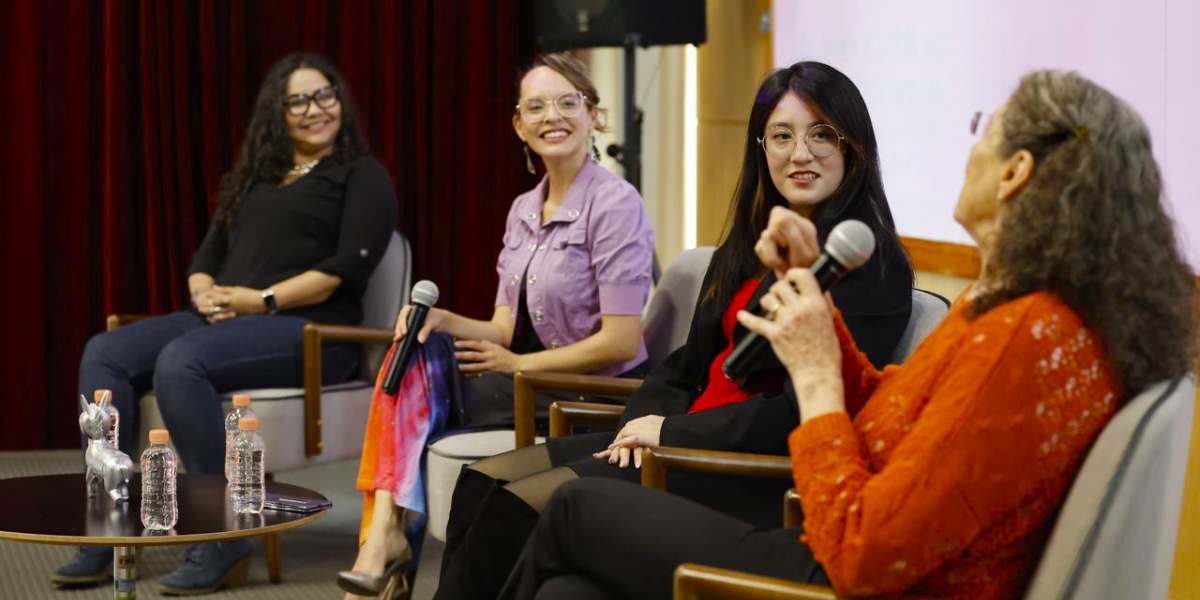
Researchers participated in the 11F forum “Ellas, Reinventando el Algoritmo,” where they addressed the challenges of Artificial Intelligence
Reflections on the risks that Artificial Intelligence (AI) poses to young people, along with the need to encourage girls from an early age to engage in science, shaped the forum Conversus Talks: “Ellas, Reinventando el Algoritmo,” held as part of the campaign “Politécnicas Abriendo Caminos.”
At the “Alfredo Harp Helú” Auditorium of the Planetario Luis Enrique Erro, scientists from the Instituto Politécnico Nacional (IPN) and the Universidad Nacional Autónoma de México (UNAM) discussed the role of women in science. They voiced institutional concerns about the excessive use of AI among youth.
Dr. Abril Valeria Uriarte Arcia, professor and researcher at the IPN’s Centro de Innovación y Desarrollo Tecnológico en Cómputo, stated that AI and autonomous learning will not, by themselves, solve the social and economic challenges faced by modern societies. Instead, she emphasized, AI should be understood as a supporting tool in areas such as healthcare and engineering. In this context, she acknowledged the overuse of AI in the daily lives of younger generations.
During the event, which was attended by students from the Centro de Estudios Científicos y Tecnológicos No. 3 “Estanislao Ramírez Ruiz,” astronomer and Emeritus Researcher at UNAM’s Institute of Physical Sciences, Gloria Suzanne Koenigsberger Horowitz, expressed concern that AI has begun to affect young people’s intellectual engagement.
“This concerns us deeply; the problem is that they are no longer using their own neurons, and if they are not exercised, they may atrophy,” she remarked, underscoring the importance of critical thinking and reflection. Both researchers agreed that while AI relies on convolutional neural networks and vast amounts of online data, a significant challenge lies in the fact that it draws from the internet, where not all information is accurate or reliable.
For Dr. Uriarte Arcia, a specialist in AI and algorithm development, the greatest challenge for women and girls seeking to enter scientific fields lies within society itself, where structural barriers must still be dismantled. She highlighted the importance of Science Weeks in technical high schools and elementary schools, as they encourage participation and demonstrate that pursuing a career in science and engineering is attainable.
Dr. Koenigsberger Horowitz also reflected on her early academic years, recalling that very few women studied at the Faculty of Sciences. “We avoided, at all costs,” she said, “walking near other faculties where there were only men, because any woman who dared to do so would be met with loud jeering.”
At the event—where attendees received T-shirts featuring the image of renowned astronomer and science communicator Julieta Fierro—Esmeralda Martínez Salgado, a social media content creator and Mechatronics Engineer from the Unidad Profesional Interdisciplinaria en Ingeniería y Tecnologías Avanzadas (UPIITA), noted that in Mexico, only 30 percent of people engaged in scientific research are women, and in engineering, they represent just 27 percent.

INSTITUTO POLITÉCNICO NACIONAL
D.R. Instituto Politécnico Nacional (IPN). Av. Luis Enrique Erro S/N, Unidad Profesional Adolfo López Mateos, Zacatenco, Alcaldía Gustavo A. Madero, C.P. 07738, Ciudad de México. Conmutador: 55 57 29 60 00 / 55 57 29 63 00.
Esta página es una obra intelectual protegida por la Ley Federal del Derecho de Autor, puede ser reproducida con fines no lucrativos, siempre y cuando no se mutile, se cite la fuente completa y su dirección electrónica; su uso para otros fines, requiere autorización previa y por escrito de la Dirección General del Instituto.

