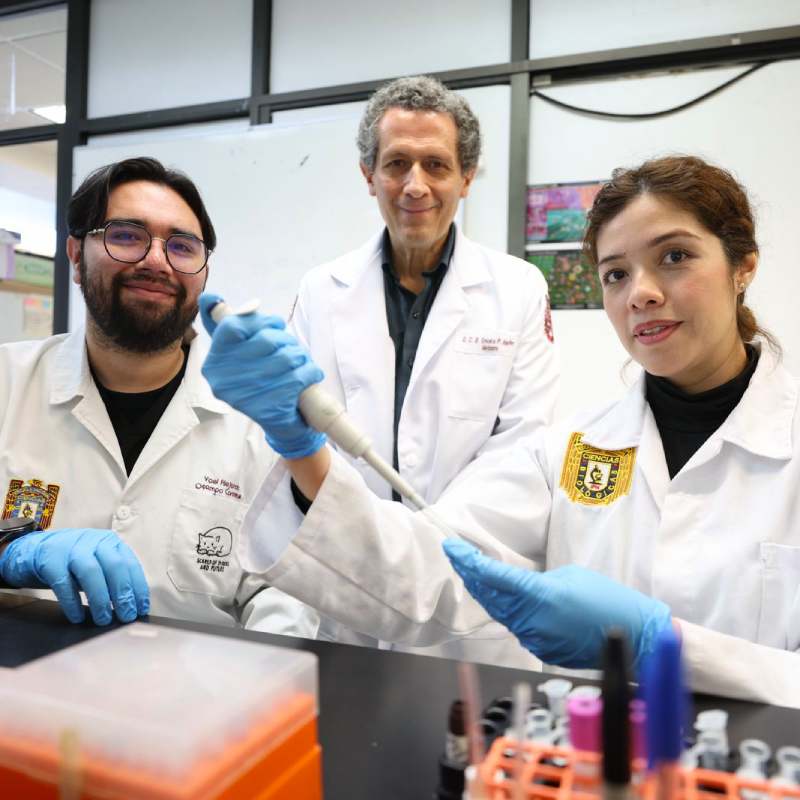
• The Escuela Nacional de Ciencias Biológicas and the Escuela Superior de Medicina are working together on this project aimed at transforming the lives of patients with injuries.
• Researcher Jorge Vela Ojeda notes that Artificial Intelligence will help accelerate laboratory progress; the countries most advanced in this field are the United States, Spain, England, and Germany.
The Instituto Politécnico Nacional (IPN) has achieved a medical milestone by successfully regenerating bone, cartilage, muscle, and adipose tissue from stem cells—specifically mesenchymal stem cells extracted from bone marrow. This breakthrough represents a significant step forward for regenerative medicine in Mexico, aiming to enhance the quality of life for patients suffering from various injuries.
The project is led by Jorge Vela Ojeda, a scientist from the Department of Morphology, and Elba Reyes Maldonado, coordinator of the Hematopathology Specialty Program, both affiliated with the Escuela Nacional de Ciencias Biológicas. Their research initiative, “The Importance of Hematopoietic Stem Cells in Tissue Regeneration,” is conducted in collaboration with specialists from the Escuela Superior de Medicina and the Instituto Mexicano del Seguro Social (IMSS).
The research aligns with public health priorities promoted by Claudia Sheinbaum Pardo, President of Mexico, and Mario Delgado Carrillo, Secretary of Public Education.
Vela Ojeda—who holds a master’s degree and a PhD in Chemical-Biological Sciences and is ranked Level III in Mexico’s Sistema Nacional de Investigadoras e Investigadores (SNII)—emphasized that Artificial Intelligence will play a key role in regenerative therapies by supporting laboratory processes. “It will help this field develop much faster,” he noted.
The IPN researcher explained that stem cells can be manipulated not only to produce blood, muscle, fat, and connective tissue, but also possess pluripotent functions. This means they can regenerate these tissues and potentially form cells for the heart, brain, nervous system, stomach, and virtually any organ in the body.
He stressed that IPN’s research is progressing steadily and that the next step will be to apply—under all required regulatory frameworks—the bone, cartilage, muscle, and adipose tissue generated from stem cells in patients. For this stage, support from the Instituto Mexicano del Seguro Social will be essential.
Vela Ojeda described the research process: within plastic structures, or scaffolds, created using 3D printers, researchers place mesenchymal stem cells. These cells generate specific forms of bone, connective tissue, and muscle tissue, allowing them to adapt to the needs of a non-healing fracture or a specific organ.
The IPN researcher clarified that mesenchymal stem cells—capable of regenerating bone, muscle tissue, and cartilage—belong to the broader group of hematopoietic stem cells found in bone marrow.
The scientist, who served for 23 years as head of the Hematology Department at the Specialty Hospital of the Centro Médico Nacional La Raza, explained that the simplest way to extract hematopoietic stem cells is through bone marrow aspiration using a needle inserted into the iliac crest, where these cells are found in sufficient quantities.
“Mesenchymal stem cells are also present there in smaller amounts, but the cells we extract can be expanded in the laboratory and used to restore a damaged organ. These cells can also be found in umbilical cord blood,” he added.
According to the researcher, the countries that have advanced the most in regenerative therapies using stem cells are the United States, Spain, England, and Germany.
For more information, visit www.ipn.mx

INSTITUTO POLITÉCNICO NACIONAL
D.R. Instituto Politécnico Nacional (IPN). Av. Luis Enrique Erro S/N, Unidad Profesional Adolfo López Mateos, Zacatenco, Alcaldía Gustavo A. Madero, C.P. 07738, Ciudad de México. Conmutador: 55 57 29 60 00 / 55 57 29 63 00.
Esta página es una obra intelectual protegida por la Ley Federal del Derecho de Autor, puede ser reproducida con fines no lucrativos, siempre y cuando no se mutile, se cite la fuente completa y su dirección electrónica; su uso para otros fines, requiere autorización previa y por escrito de la Dirección General del Instituto.