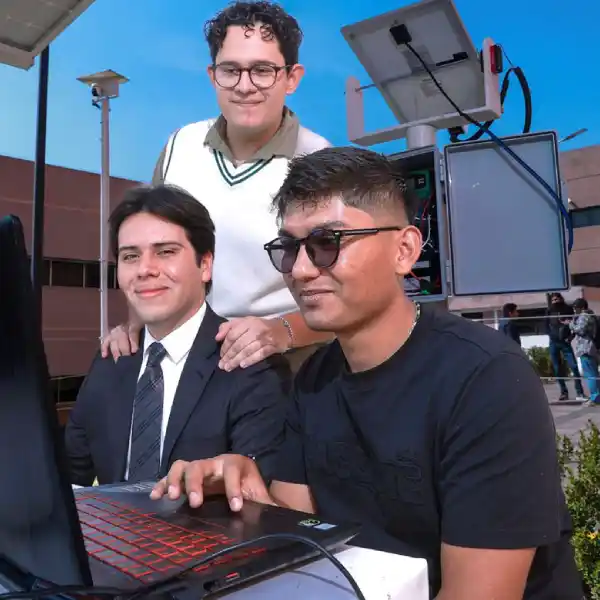
• UPIITA students use a water-level sensor, a control box, and a solar tracker to determine potential hazards from rainfall in real time
• The proposal draws on data from Mexico City’s Risk Atlas; its creators propose installing multiple devices across Mexico City and other urban areas To issue alerts about risks to vehicle mobility, infrastructure damage, and even potential loss of life due to flooding or overflow caused by the heavy rains that occur during certain times of the year, students from the Instituto Politécnico Nacional (IPN) developed a flood detection system featuring intelligent prediction and IoT (Internet of Things) sensors.
The system, created by Armando Rodríguez Blanco, Alejandro Emiliano Reyes Hernández, and Sergio Zaldívar Díaz—students at the Unidad Profesional Interdisciplinaria en Ingeniería y Tecnologías Avanzadas (UPIITA)—consists of a pole equipped with a water-level sensor at the bottom, a control box, and a solar tracker mounted at the top.
To generate alerts, the students relied on two types of data: the percentage of flood-prone area—indicating how susceptible a zone is to flooding according to the Atlas de Riesgos de la Ciudad de México—and rainfall levels measured in millimeters, which reflect the intensity of precipitation in a given region.
The development of this prototype aligns with the Mexican government’s vision of prioritizing social well-being, promoted by President Claudia Sheinbaum Pardo and under the guidelines established by the Secretary of Public Education, Mario Delgado Carrillo.
The system includes a microcontroller responsible for both the solar panel’s movement logic and data transmission. It receives readings from the water-level sensor, processes them, and sends them via Wi-Fi to any device with the application installed and connected to the internet.
“The key component of the system is the software development, which enables anyone with the app to receive alerts on a mobile device,” explained Armando Rodríguez.
Inside the control box is a solar charge controller that optimizes the power generated by the panel, along with a high-performance lithium iron phosphate battery that provides the system with full energy autonomy.
“With this data—alongside information from the Risk Atlas and historical precipitation records for a given region—collected from the prototype’s water-level sensor, our predictive model evaluates filling trends, performs real-time risk forecasting, and publishes alerts on a web platform,” added Sergio Zaldívar.
The students’ goal is to install multiple devices in Mexico City streets that have experienced the highest levels of flooding and to make the information as easy to consult as a traffic app, helping users avoid potentially dangerous areas.
The proposal aligns with the smart city trend, which the students adopted as part of their capstone project to earn their degree in Mechatronics Engineering—an idea inspired by an academic mobility trip to Europe.
Developed under the guidance of professors Helvio Mollinedo Ponce de León and Miguel Félix Mata Rivera from UPIITA, as well as Roberto Eswart Zagal Flores from the Escuela Superior de Cómputo (Escom), the system represents an initial step toward accessible technological solutions for monitoring and issuing flood-risk alerts in specific areas.
For more information, visit www.ipn.mx

INSTITUTO POLITÉCNICO NACIONAL
D.R. Instituto Politécnico Nacional (IPN). Av. Luis Enrique Erro S/N, Unidad Profesional Adolfo López Mateos, Zacatenco, Alcaldía Gustavo A. Madero, C.P. 07738, Ciudad de México. Conmutador: 55 57 29 60 00 / 55 57 29 63 00.
Esta página es una obra intelectual protegida por la Ley Federal del Derecho de Autor, puede ser reproducida con fines no lucrativos, siempre y cuando no se mutile, se cite la fuente completa y su dirección electrónica; su uso para otros fines, requiere autorización previa y por escrito de la Dirección General del Instituto.