
Reporter: Adda Avendaño / Photographer: Javier González
The hydraulic motor mechanism holds patents granted by the Mexican Institute of Industrial Property (IMPI) and could be applied across the mechanical, textile, and other industries.
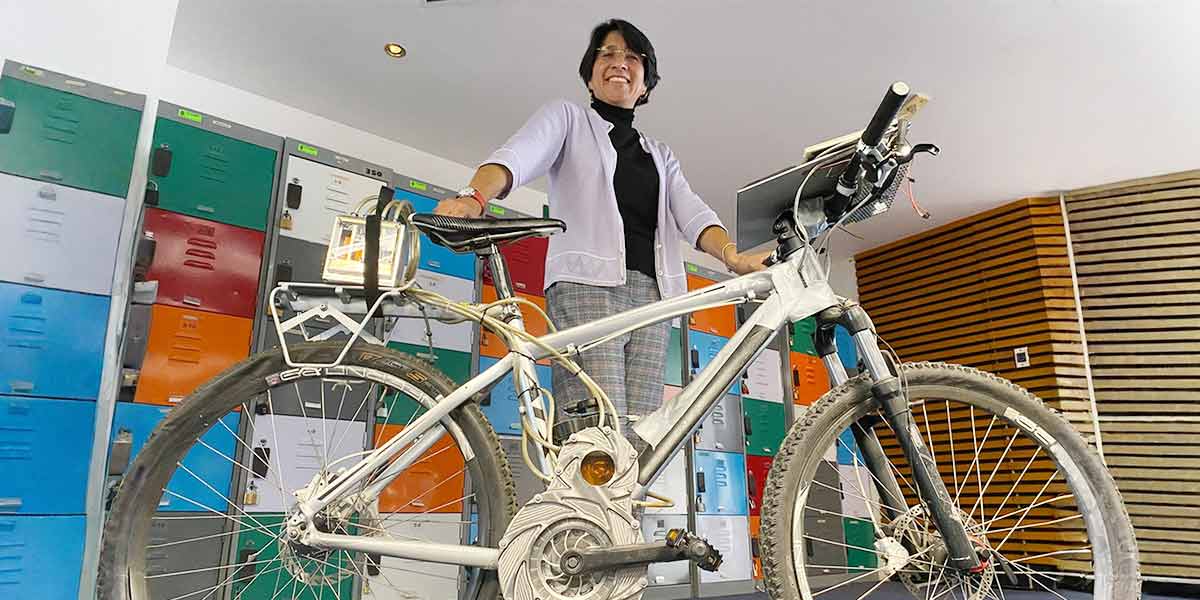
At the Research Center for Computing (CIC) of the Instituto Politécnico Nacional (IPN), researchers have developed an innovative device capable of replacing traditional bicycle chain systems with safer hydraulic motors. The technology has been awarded three patents by the Mexican Institute of Industrial Property (IMPI).
The IPN-developed model originated from a personal experience of Raymundo Iván Sánchez Peregrina while completing his social service at the CIC. During a mountain descent on his bicycle, a gear change caused the chain to derail, resulting in an accident. This incident prompted him to explore the possibility of replacing conventional mechanical systems with a hydraulic alternative.
With guidance from Dr. Elsa Rubio Espino and Dr. Juan Humberto Sossa Azuela—both faculty members and researchers at the CIC—Sánchez Peregrina designed a sealed, cardioid-shaped (heart-shaped) mechanism intended to replace the bicycle’s main gear near the pedals and function as the power source.
Dr. Elsa Rubio Espino, Head of the Robotics and Mechatronics Laboratory, explained that the goal is to replace traditional gear mechanisms with a system that transmits force to mechanical components using pressurized oil. The main advantages include smoother pedaling and enhanced braking safety.
The positive-displacement hydraulic pump with magnetic coupling uses magnetic poles to generate the initial impulse. It also incorporates a servo-assisted multi-fluid dispenser, consisting of one inlet hose and four outlet hoses, which gradually supplies oil to the pump as the vehicle’s speed increases.
“This design is so versatile that it can be adapted for use in industries such as pharmaceuticals, food processing, biomedical engineering, agriculture, mechanics, and textiles, among others. Its sealed structure allows it to dispense water, oil, or other fluids—even with particulates—without contamination,” she noted.
These mechanisms formed part of Raymundo Sánchez’s undergraduate thesis to earn his degree in Control and Automation Engineering from the Escuela Superior de Ingeniería Mecánica y Eléctrica (ESIME), Zacatenco campus. Due to their high level of innovation, both developments were granted patents by IMPI on July 19, 2023, and June 17, 2024, respectively.
Building on this work, the research team designed a third prototype known as the Positive-Displacement Hydraulic Motor with Magnetically Coupled Moving Vanes, a mechanism that converts hydraulic energy into continuous rotational motion.
Dr. Rubio Espino—also a Level III member of Mexico’s National System of Researchers (SNII)—explained that the moving vanes, similar to blades that open and close as oil enters or exits the motor housing, fill progressively as oil flow increases. This process enables smooth gear changes.
“In our proposal, pedaling determines the amount of oil used by the motor. The greater the force applied while pedaling, the more oil is displaced into each cavity, resulting in increased speed,” she explained.
The complete mechanism, which received its patent on July 22, 2025, is designed to maintain a constant speed, making it particularly safe for children and older adults who wish to ride a bicycle.
Dr. Rubio Espino added that, with all three patents secured, the creators plan to manufacture and commercialize a kit that replaces the traditional bicycle chain system with a hydraulic alternative that is easier and safer to operate.

INSTITUTO POLITÉCNICO NACIONAL
D.R. Instituto Politécnico Nacional (IPN). Av. Luis Enrique Erro S/N, Unidad Profesional Adolfo López Mateos, Zacatenco, Alcaldía Gustavo A. Madero, C.P. 07738, Ciudad de México. Conmutador: 55 57 29 60 00 / 55 57 29 63 00.
Esta página es una obra intelectual protegida por la Ley Federal del Derecho de Autor, puede ser reproducida con fines no lucrativos, siempre y cuando no se mutile, se cite la fuente completa y su dirección electrónica; su uso para otros fines, requiere autorización previa y por escrito de la Dirección General del Instituto.

